Canticle Book Review: 12 Miracles, 1 Cell—Did She Earn It?
Imagine being sixteen, seeing visions of God, then getting locked in a stone box for life because a power-hungry bishop decided your divine gifts would make a cracking PR stunt. That’s Aleys’s reward in Janet Rich Edwards’s debut novel, and honestly? The book makes you wonder if she walked straight into the trap with her eyes wide open, singing hymns the whole bloody way.
Keys:
- Why Aleys trades friendship for fanaticism and ends up bricked into an anchorite cell
- How a Franciscan friar named Lukas gets spiritually jealous of a teenage girl’s visions
- The Beguine women who offer freedom—then watch it all collapse
- Whether those 12+ miracles were worth the ultimate sacrifice (spoiler: probably not)
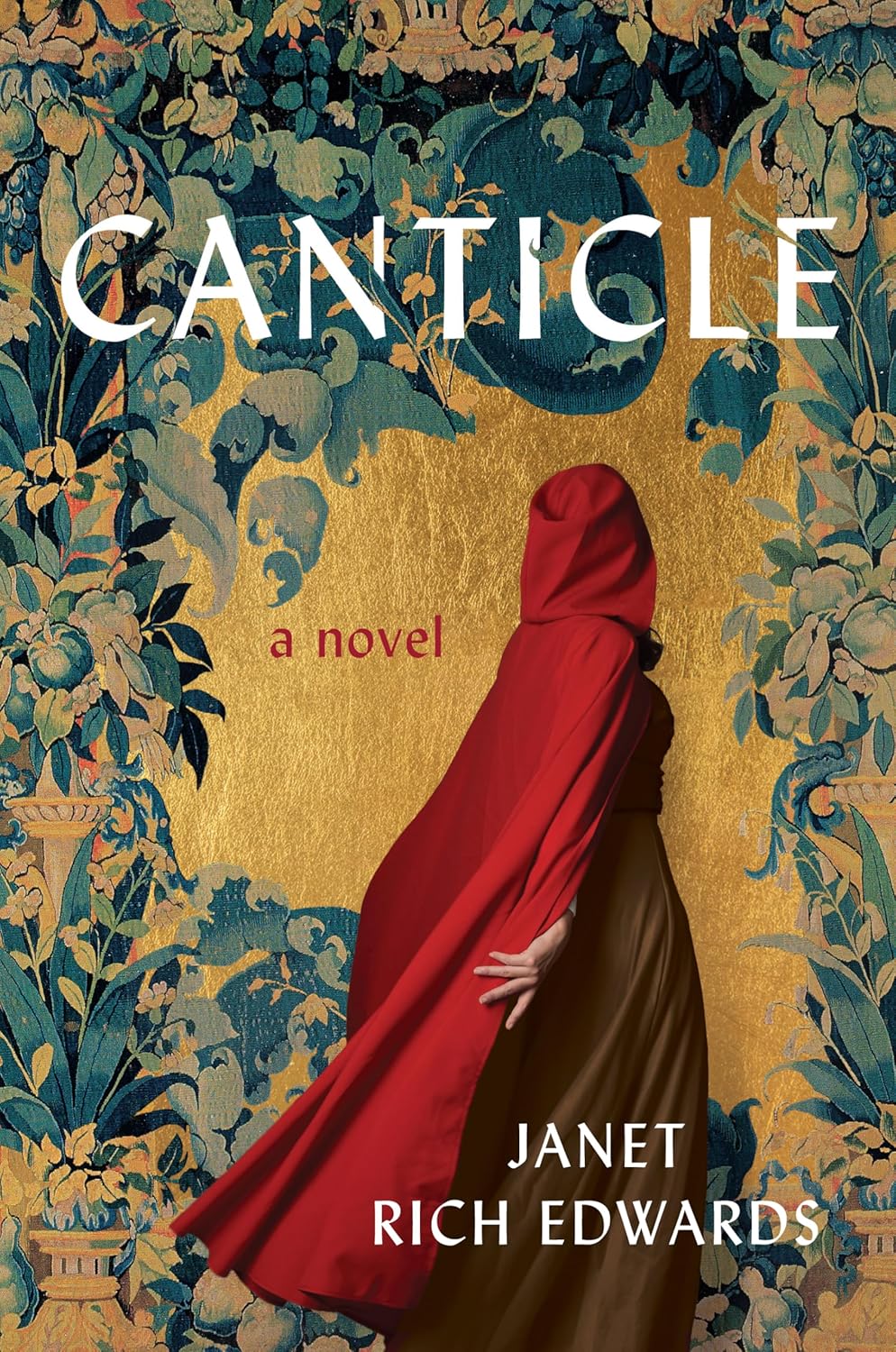
Detailed Summary
Part One: The Wool Merchant’s Odd Daughter
Aleys isn’t your average medieval teenager in 13th-century Damme, near Bruges. She’s the daughter of a wool merchant desperate to climb the social ladder, but she’s “powerfully odd”—seeing bright, terrifying visions that she believes come straight from God. Her mother tells her stories of saints and prophets, feeding an obsession that’ll eventually consume her entire existence.
She finds one friend in this suffocating world: Finn, a young scholar. They meet in secret to learn Latin together, which is absolutely forbidden for girls. Latin means access to scripture, to knowledge, to power that the Church hoards like dragons guard gold. For a brief moment, Aleys thinks maybe their intellectual connection could become something more romantic, something human and warm.
But her father has other plans. He promises her in marriage to the head of the weavers’ guild, an “unctuous” merchant who’ll secure the family’s position. The man repulses her. Her visions intensify, showing her a different path entirely—one that leads away from marriage beds and domestic drudgery toward something she interprets as divine calling.
Everything unravels when the marriage arrangement becomes concrete. Aleys makes a desperate choice: she runs. No plan, no money, just blind faith that God will provide. She flees into the unknown, leaving behind Finn, her family, and any chance at the normal life medieval women are supposed to want.
Part Two: Finding the Beguines
Wandering and vulnerable, Aleys encounters a Franciscan friar named Lukas. He’s a man torn by his own spiritual inadequacies—he’s dedicated his life to God with fervor and discipline, yet he’s never experienced the divine visions this teenage girl describes with such casual certainty. You can practically taste his jealousy mixed with genuine curiosity.
Lukas arranges for Aleys to shelter with the Beguines, a radical community of women living in the begijnhof in Bruges. These women have created something extraordinary: a space where they answer to no male authority, not the Church, not husbands, not fathers. They work in the cloth trade, study, pray, and govern themselves. For medieval women, this is freedom bordering on heresy.
Among the Beguines, Aleys discovers joy she’s never known. She experiences real friendship with strong-willed women who sing together, work the markets, and walk along Bruges’s canals with a sense of purpose and belonging. They teach her about community, about supporting one another, about living a spiritual life that doesn’t require suffering and isolation.
The Beguines are also involved in something dangerous: translating scripture from Latin into Dutch. They believe common people deserve to read God’s word in their own language, without priests as gatekeepers. It’s illegal, borderline heretical, and exactly the kind of activity that draws unwanted attention from Church authorities who prefer their flock ignorant and obedient.
Part Three: Miracles and Manipulation
Aleys’s visions don’t stop—they intensify. She begins performing miracles, or at least acts that witnesses interpret as miracles. Word spreads through Bruges like wildfire. The common people, desperate for signs of divine favour in their harsh lives, flock to her. She becomes a phenomenon, a local saint in the making.
This is where an ambitious bishop enters the story. He’s less interested in Aleys’s spiritual authenticity than in how her popularity can serve his career ambitions. In the 13th century, having a living saint or mystic in your diocese is like striking gold—it brings pilgrims, donations, and most importantly, the attention of higher Church authorities who control promotions.
The bishop sees an opportunity and begins spinning a complex web. He approaches Aleys with what seems like validation: official Church recognition of her visions, a chance to serve God in a profound way. Lukas, her mentor, is conflicted. Part of him recognizes the bishop’s manipulation, but another part wonders if this truly is God’s plan for Aleys.
The Beguine community grows increasingly nervous. The bishop’s attention on one of their own brings scrutiny to their entire operation. Their independence, their illegal translations, their refusal to submit to male Church authority—all of it becomes vulnerable. Some Beguines urge Aleys to be cautious, to recognize the political games being played with her soul as the prize.
Part Four: The Anchorite’s Cell
The bishop’s ultimate scheme: convincing Aleys to become an anchorite. This isn’t just becoming a nun—it’s far more extreme. An anchorite is walled alive into a small cell attached to a church, with only a tiny window for receiving food and providing spiritual counsel to visitors. It’s a living burial, justified as the ultimate form of devotion and sacrifice.
To Aleys, intoxicated by her visions and convinced of her divine mission, this seems like the culmination of everything she’s been called to do. The bishop frames it as the highest honour, the most profound way to serve God. Lukas watches, tormented by doubts he can’t articulate forcefully enough to stop what’s happening.
The ceremony takes place. Aleys enters the cell. The masons begin bricking up the entrance, leaving only that small window. The crowd watches this seventeen-year-old girl being entombed alive, and they weep tears of religious ecstasy, believing they’re witnessing holiness. The bishop presides, satisfied with his acquisition of a captive saint who’ll draw the faithful for years to come.
Inside the cell, Aleys begins her new existence. She prays, she receives visitors who seek her counsel through the window, she subsists on meager food passed through by attendants. The Beguine women visit when they can, but the connection is severed—she’s no longer part of their community of equals but elevated (or reduced) to something else entirely.
Part Five: Realization and Cost
As days turn into months in the cell, something shifts in Aleys’s understanding. The visions continue, but she begins seeing them differently. Was this really God’s plan, or was she manipulated by men who used her genuine spiritual experiences for their own advancement? The romantic, mystical vision of anchorite life confronts the brutal physical reality: cold stone, isolation, no movement, no sunlight, no human touch.
Edwards doesn’t spell out whether Aleys regrets her choice—that would be too simple. Instead, she shows a young woman grappling with the complexity of faith, power, and female agency in a world designed to crush all three. The bishop visits occasionally, always performing for an audience, using Aleys’s presence to bolster his reputation.
The Beguines face their own reckoning. The increased scrutiny from Church authorities leads to investigations of their community. Their translations are discovered. Their independence is challenged. Women are questioned, pressured to submit to traditional monastic authority or face accusations of heresy.
Lukas, too, must confront his role in Aleys’s fate. His spiritual jealousy, his inability to stand firmly against the bishop, his complicated mix of genuine care and self-interest—all of it weighs on him. He provided the initial connection that led Aleys to the Beguines, but he also failed to protect her from institutional forces far more powerful than one conflicted friar.
Part Six: Consequences and Legacy
The novel’s conclusion brings devastating clarity. The bishop’s ambition is satisfied—he’s gained recognition and advancement through his association with the “holy anchorite.” Aleys remains in her cell, her youth and vitality slowly consumed by stone walls and forced isolation. The miracle worker becomes a permanent exhibit, her humanity sacrificed to others’ visions of sanctity.
The Beguine community fractures under pressure. Some women submit to Church authority, accepting enclosure in traditional convents. Others scatter, their brief experiment in female independence crushed by institutional power threatened by women who dared to define their own spiritual lives.
Edwards structures the ending to echo historical reality: women like Marguerite Porete, burned at the stake for mystical writings; countless Beguines forced into submission after the Council of Vienne outlawed their lifestyle; young female mystics throughout medieval Europe used as tools by ambitious clergy. Aleys’s story isn’t unique—it’s emblematic of how female spirituality was simultaneously celebrated and contained, honoured and exploited.
The final scenes show Aleys through her small window, still providing counsel to visitors, but with an understanding born of painful experience. She’s achieved what she thought she wanted—union with God through sacrifice—but at a cost that perhaps no sixteen-year-old should be allowed to pay, no matter how convinced she is of her divine calling.
Characters?
| Character | Role | Critical Analysis |
|---|---|---|
| Aleys | Protagonist, teenage visionary | Stubborn to the point of self-destruction. Her genuine visions get twisted by her own naivety and others’ manipulation. She trades human connection for abstract divine union and ends up trapped. The question Edwards poses but doesn’t answer: is Aleys a saint or a victim of religious grooming? |
| Finn | Aleys’s friend, young scholar | Represents the road not taken. He offered Aleys intellectual companionship and potential romantic connection, but she abandons him for her visions. He disappears from the narrative, which feels symbolic—human relationships can’t compete with divine obsession. |
| Lukas | Franciscan friar, mentor | The most complex character. Spiritually jealous of a teenage girl’s visions while genuinely trying to guide her. His failure to protect Aleys from the bishop reveals how even well-meaning men within the Church structure become complicit in institutional abuse. |
| The Bishop | Antagonist, ambitious cleric | Pure calculated ambition wrapped in religious language. He sees Aleys as a career opportunity and manipulates her faith for personal advancement. Edwards makes him a villain, but a realistic one—plenty of medieval bishops operated exactly this way. |
| The Beguine Women | Community of independent religious women | Collectively represent what Aleys could have had: spiritual life combined with community, work, and autonomy. Their ultimate persecution shows Edwards’s critique of how the medieval Church crushed female independence. |
| Aleys’s Father | Wool merchant | Drives the initial conflict by arranging the unwanted marriage. Typical medieval patriarch prioritizing business alliances over his daughter’s wishes, pushing her toward the desperate choice to run. |
Compare with Other Works
Matrix by Lauren Groff is the obvious comparison—both novels center on medieval women creating spiritual communities outside male control, both explore female mysticism, and both examine how institutional power eventually crushes female independence. But where Groff’s Marie de France builds an abbey into a fortress of female power, Edwards’s Aleys ends up literally walled into a cell. Groff offers a proto-feminist triumph; Edwards delivers a cautionary tale.
The Book of Margery Kempe parallels surface throughout Canticle. Margery Kempe’s religious visions and public weeping scandalized medieval England, but she remained mobile, travelling on pilgrimages and dictating her autobiography. Aleys loses her mobility entirely, making Edwards’s version darker and more claustrophobic than even Kempe’s often-criticized melodramatic mysticism.
Medieval mystic texts by actual Beguines—Mechthild of Magdeburg’s “The Flowing Light of the Godhead” and Marguerite Porete’s “The Mirror of Simple Souls”—inform Edwards’s portrayal. But those real women wrote and circulated their visions; Aleys becomes voiceless except through the small window of her cell, which feels like Edwards commenting on whose mystical voices get preserved versus suppressed.
Contemporary medieval fiction like The Once and Future Witches by Alix E. Harrow or The Mercies by Kiran Millwood Hargrave similarly explore women’s spiritual power meeting violent institutional resistance. Edwards fits this trend of reclaiming medieval women’s stories, but her ending is bleaker—no last-minute rescues, no triumphant sisterhood, just stone walls and missed opportunities.
Achievement
Goodreads Rating: 4.31 out of 5 stars from 164 ratings with 124 written reviews—solid for a debut, indicating strong reader response even before official publication.
Critical Recognition: Foreword Reviews awarded Canticle a rare 5-star review, placing it among their top indie fiction selections. That’s significant given Foreword Reviews receives thousands of submissions annually and distributes fewer than 3% of five-star ratings.
Foreign Rights Sales: Italian publisher Astoria/Mauri Spagnol acquired translation rights before the English-language release, indicating international publisher confidence in the novel’s commercial and literary potential. Foreign rights deals for debut historical fiction are notoriously difficult to secure.
Publication Details: Spiegel & Grau (a Knopf Doubleday/Random House imprint) published Canticle with a December 2, 2025 release date. Landing a Big Five publisher for debut literary historical fiction represents a significant achievement—the rejection rate exceeds 99% for unsolicited manuscripts.
Endorsements: Edwards secured advance praise from established authors including Sarah Dunant (New York Times bestseller of The Birth of Venus), Bruce Holsinger (literary medieval fiction specialist), and Kiran Millwood Hargrave (The Mercies). These endorsements from respected historical fiction authors indicate industry recognition.
Author Background: Janet Rich Edwards is a Harvard epidemiology professor who published over 300 scientific papers before writing her debut novel, bringing academic rigor to historical research. This dual expertise shows in the novel’s meticulous historical detail regarding 13th-century Beguine communities and medieval mysticism.
Market Positioning: Released during a surge in medieval women’s historical fiction popularity (following Matrix’s success), Canticle enters a receptive market. However, unlike romantasy trending on BookTok, this literary approach may limit mainstream breakout potential.
Historical Accuracy Worth Noting
Edwards nails the Beguine movement’s complexities. These women really did create independent communities in 13th-century Low Countries (modern Belgium/Netherlands), worked in cloth trades, and faced persecution culminating in the 1311 Council of Vienne that officially outlawed their lifestyle.
The illegal vernacular Bible translations are historically accurate—translating scripture into common languages was considered dangerous heresy that undermined Church authority. People were burned alive for possessing Dutch, French, or English Bibles.
Anchorites genuinely existed and were walled into cells, sometimes for decades. Julian of Norwich is the most famous English anchorite, but hundreds of women across medieval Europe chose (or were coerced into) this extreme form of religious devotion.
The detail about Damme’s connection to Bruges via the Zwin canal is precise—Damme served as Bruges’s outer port in the 13th century because larger trading ships couldn’t navigate all the way into the city proper.

Twenty-four-year-old Prue sacrifices everything to care for her mum with early-onset Alzheimer's in small-town Ontario, writing poetry between shifts at the family servo. Then tattooed wanderer Milo rolls into town in his dodgy van, and ...

G'day, mates – imagine a house where the bloody wallpaper starts whispering your darkest secrets, and you're trapped in a loop of grief so thick it chokes you like a bad barbie snag. That's the ...
Why This Book Frustrates
Edwards writes beautifully—the prose is luminous, the historical research impeccable, the characters psychologically complex. But the narrative asks readers to watch a bright, curious teenager get manipulated into a living tomb while everyone around her either actively exploits her or fails to intervene effectively.
There’s no triumph here, no empowerment, just an object lesson in how patriarchal religious institutions have always used women’s genuine spirituality against them. That’s historically honest but emotionally punishing.
The comparison to Matrix hurts this book. Groff gave readers a powerful abbess building a female utopia; Edwards gives us a girl bricked into a wall. Both are valid medieval women’s stories, but one offers catharsis and the other offers only frustration.
Aleys herself is difficult to root for because her choices seem increasingly self-destructive. She abandons human connection, ignores warnings, and embraces her own entombment. Edwards wants us to see her as manipulated, but Aleys’s agency in her own fate complicates any simple victim narrative.
Final Verdict
Canticle is technically accomplished, historically rigorous, and thematically depressing. Edwards has crafted a gorgeous tragedy about how medieval women’s spiritual gifts became prisons, both literal and metaphorical. The writing deserves recognition, the research is beyond reproach, and the emotional impact is undeniable—but not in a way that makes you want to recommend it widely.
If you loved Matrix and want the opposite energy—female mysticism leading to crushing containment rather than liberation—this book delivers. If you’re fascinated by Beguines, medieval women’s history, or the dark side of religious institutions, Edwards provides essential reading.
But if you’re seeking uplift, hope, or even bittersweet triumph, look elsewhere. This is medieval misery rendered with literary skill and no interest in softening the historical reality that women like Aleys were used, trapped, and discarded by men who claimed to serve God.
The 4.31 Goodreads rating and 5-star Foreword Reviews suggest many readers appreciate Edwards’s unflinching approach. But plenty of us will finish this beautifully written novel feeling gut-punched and questioning why anyone would willingly walk into a stone cell and let masons brick up the entrance.
Reckon this review hit the mark, or did Aleys deserve her fate? Drop a comment below—I’m keen to hear whether you think she’s a saint or a cautionary tale. And if this deep dive helped you decide whether to read Canticle, chuck me a small donation or click those ads to keep these reviews coming. Share this with your medieval fiction mates and let’s argue about whether Edwards nailed it or just nailed Aleys into a coffin.
G'day, mates. Ever reckon a book could gut-punch you with foster care horrors while dangling Ojibwe secrets like a carrot on a stick? Sisters in the Wind kicks off with Lucy Smith, this tough-as-nails teen ...
G'day, you lot of dark fantasy junkies! Imagine this: you're trudging through a foggy bog of flesh-munching monsters and cursed blokes, only to trip over plot holes bigger than the Sydney Harbour. What if the ...